

My short story ‘Death in the Dolomites’ was read by Clareine Cronin at this year’s Liars’ League ‘Women & Girls’ storytelling event – you can read, watch, or listen to the story here.
I began writing this story in response to the Liar’s League call for submissions for Agatha Christie-inspired stories, to commemorate the 50th anniversary of Christie’s death. I love Agatha Christie’s stories, Poirot in particular, because he’s such a fun character to read, and because he travelled to some amazing places, solving perplexing mysteries in all of them. Death on the Nile, Murder on the Orient Express, The Mystery of the Blue Train – is there anywhere this man hasn’t been and found a body?!
Initially, I pondered the features of a typical Christie plot. As I said in an earlier post, Christie’s plots usually result in unexpected outcomes (at least, for me they do), in terms of who committed the crime and how, but as much as I would have liked to copy her style, poisoning a character with cyanide while the protagonist’s hapless sidekick barks up the wrong tree until ultimately it’s revealed that the murderer is the character the reader least expected, my brain just doesn’t work like Christie’s. Instead, my murder was inspired by recent newspaper stories and social media posts relating to the modern phenomenon of ‘alpine divorce’, simply because it’s something that stuck in my mind and I wanted to write about it.
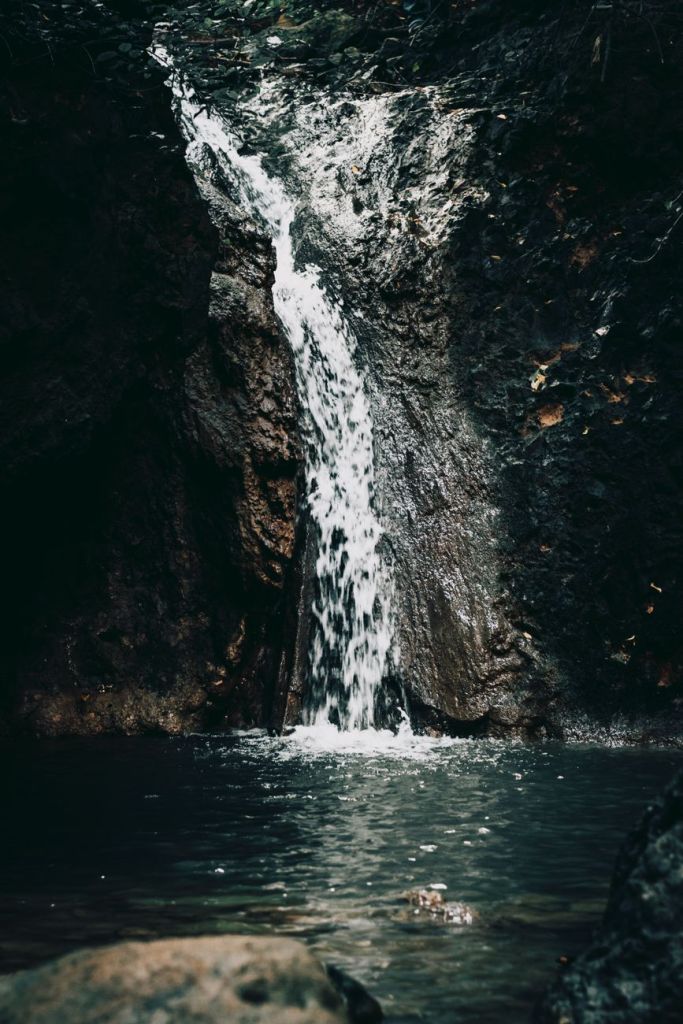
When I write, I usually start at the end of the story. In this instance, I imagined a murder on the edge of a cliff being interrupted by a bear coming out from behind a tree; I like the humour and irony of it, it’s a nice little nod to the ‘choose the bear’ debate, and animals often feature in my stories so it’s in keeping with my usual style. I wanted to set the story in Europe, as many of Christie’s novels and stories are, so I researched where in the Alps you can find bears, and set the story there – Madonna di Campiglio, Italy. Details that my research uncovered helped shape the story, for example a real-life waterfall in this location gave my characters a reason to be standing on the edge of the cliff.
I chose a third-person objective narrator because I didn’t want to reader to see inside the protagonist’s head (or the antagonist’s) – I think it’s more ominous this way, as the reader doesn’t know what either character is thinking or feeling, so initially the reader will be unsure what’s really going on beneath the surface, and I wanted the ending to be a surprise. I used a mixture of present and past tense to make it clear what’s happening now and what happened previously; each flashback to the past reveals more information, which slowly fills in the background, and builds tension.
I enjoyed writing this story. If you’re interested in submitting to Liar’s League, have a look at their upcoming themes.

